Want to install a wallbox at home and don’t know where to start? In this technical guide you will find out everything you need: electrical system requirements, mandatory protections, wiring, safety, regulations, and smart features.
Installing a wallbox in your garage or home is one of the smartest choices for those who drive an electric car and want to recharge in a safe, fast and controlled manner. However, there are fundamental technical aspects behind this decision that need to be carefully evaluated: the type of system, the protections, the electrical panel, and the relevant regulations.
In this comprehensive guide, we will look in detail at what is needed for a proficient home wallbox installation.
Single-phase or three-phase system: requirements for installing a wallbox
The first and most important requirement for installing a wallbox is to match the type of your household electrical system. In Italy, thesingle-phase system with a 3 or 6 kW meter-the most common household standard-allows the installation of wallboxes with power ratings up to 7.4 kW.
For faster recharging, with 11 kW or 22 kW wallboxes, it is essential to have a 400 V three-phase system and an available power not less than that of the wallbox itself (at least 11 kW).
To check the power available and the type of your system, simply consult your electric bill, or you can contact your energy supplier for any adjustments.
Electrical panel for wallbox: protections and dedicated line
The wallbox must be connected to a dedicated line that is completely separate from the rest of the household system. For safe charging, it is essential to set up a wallbox switchboard with dedicated protections and complying with IEC 64-8.
This means that you will need to install, within your electrical panel, a specific circuit with the following fundamental protections for safety and charging efficiency
- Differential protection: compulsory, must be type A with DC current detector, or alternatively directly type B, specifically for electric vehicle (EV) charging devices. This protection is crucial to prevent risks from fault currents.
- Circuit breaker protection: should be selected and calibrated according to the power rating of the wallbox. For example, a 32A circuit breaker will be required for a 7.4 kW wallbox.
Thewallbox circuit breaker should be selected according to the power rating of the device and the type of installation, also taking into account the environmental conditions of installation. Type B differential protection is mandatory in contexts where the wallbox does not integrate the DC detector and is highly recommended for professional or shared installations.
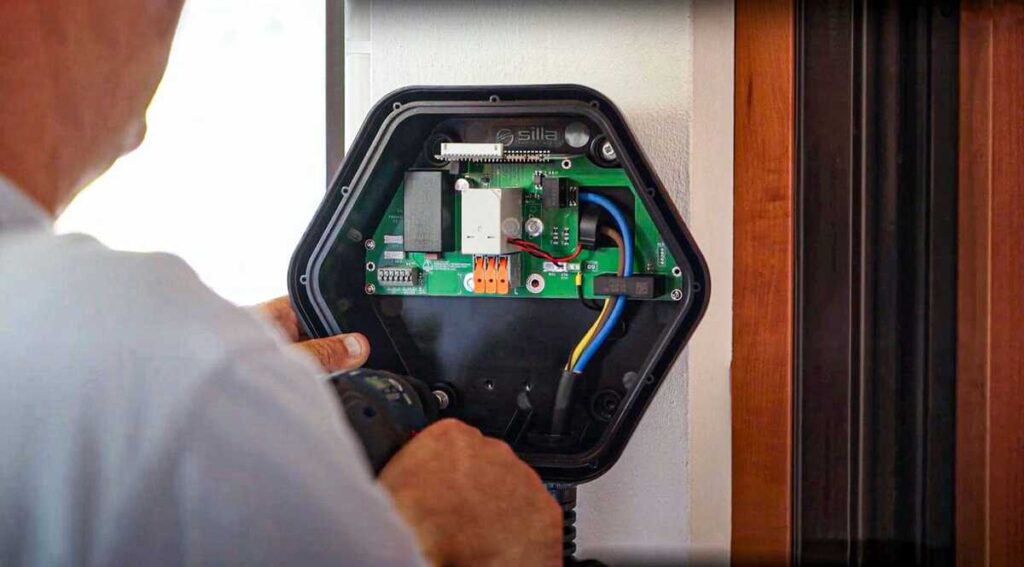
Alternatively, one can opt for a product that already integrates DC leakage protection directly into the wallbox itself, such as Silla Industries’Homer or Prism models . This solution greatly simplifies installation, reducing the cost related to the external components needed. In fact, in this case, a 0.03 A type A differential and C-curve magneto-thermal protection device will be sufficient upstream of the power line.
Wallbox cables: section, laying and technical standards
The cable feeding the wallbox should have an appropriate cross-section, calculated according to the power of the wallbox and the distance between the switchboard and the charging point. For example, for a 7.4 kW wallbox placed at a distance of 10-15 meters from the switchboard, a cross-section of 6 mm² is recommended. For longer lengths or higher powers, the cable cross section will need to be recalculated by a professional.
The laying of the wallbox cable must be done inside a wallbox cable duct, or by means of rigid protective conduit, in accordance with IEC regulations and depending on the degree of exposure. In fact, the cable used must be an EV cable certified for fixed use, with insulation suitable for the environmental conditions and power rating of the wallbox.
Grounding and safety: the basic requirements for charging
A home electric charging system requires an efficient grounding system that complies with IEC 64-8, with resistance values within established limits to ensure maximum safety. It is essential:
- the presence of equipotential bonding, which ensures that all metal masses are at the same electrical potential, preventing electrical shocks;
- the ground fault check, a check that must be carried out by a qualified technician to ensure the proper functioning of the protection system.
In addition, wallboxes must be installed in dry and protected environments. If placed outdoors, they must have a minimum IP54/IP55 rating to resist dust and water jets.
Who can install a wallbox: regulations and declaration of compliance
It is important to hire a certified wallbox installer, registered with the Chamber of Commerce with a letter A and/or B rating, who can work on low-voltage electrical systems.
The installation of a wallbox is not something to be improvised. IEC 64-8 requires that the installation be done by a registered professional (letter A or B). This ensures that the technician has the necessary qualifications to work on electrical installations.
Upon completion of the work, the installer issues the Declaration of Conformity (DiCo): the declaration of conformity of the charging system, an essential document to ensure the technical traceability of the intervention and adherence to current regulations.
This document certifies that the installation has been done in a workmanlike manner, guaranteeing access to any government incentives available for the installation of charging infrastructure, insurance coverage in case of accidents or malfunctions related to the installation, and the legal security of your charging facility.
Silla Industries also offers an installation service carried out through a selected network of certified Partners, available throughout Italy, thus guaranteeing professionalism and compliance.
Smart wallbox functionality: DLM, photovoltaics and access control
Modern wallboxes do more than just provide power to the vehicle; they offer a range of smart features that improve the charging experience and energy efficiency, such as
- Dynamic Load Management (DLM): this intelligent function adjusts the power drawn by the wallbox in real time, adapting it to household electricity consumption. This is critical to avoid blackouts when meter power is limited and optimizes the use of available energy.
- Integration with PV system: allows you to use the surplus energy produced by your PV system to recharge your vehicle, reducing costs and maximizing self-consumption. This functionality requires the use of a smart meter.
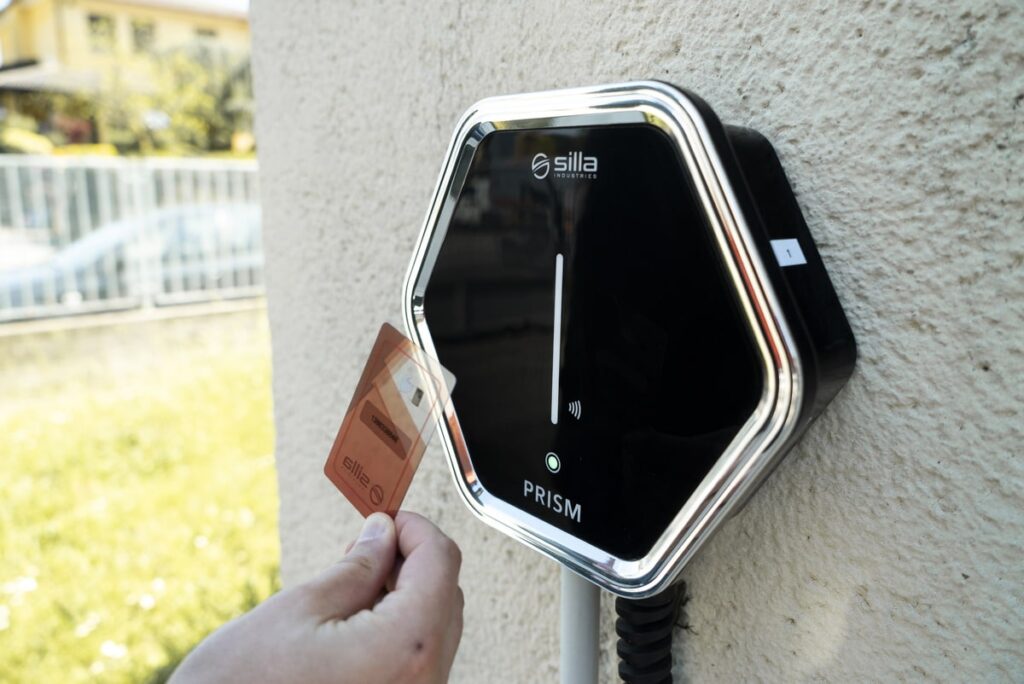
- RFID authentication or app-based control: useful in shared settings such as apartment buildings, communal garages or businesses, these features allow monitoring of wallbox access and the energy used by each user.
Silla Industries’ Prism wallbox is an example of a solution that offers all these integrations. It is a wallbox with integrated protections that can be installed in both single-phase and three-phase systems, with full support for DLM and photovoltaic integration. It is also compatible with app control, RFID authentication and cloud monitoring for complete management.
Wallbox in condominium or garage: permits and regulations
The installation of a wallbox in a private home generally does not require specific permissions. However, the situation changes in the case of installation in a condominium, where it is necessary to inform the condominium administrator of your intention and obtain permission from the condominium assembly. In some cases, if you are not modifying the common parts of the building, a simple notification may be sufficient, but it is always best to check with the administrator.
In garages subject to fire prevention, the installation of a wallbox is subject to more stringent regulations. In these environments, a plan signed by a licensed professional (engineer or industrial expert with specific fire prevention skills) is mandatory to ensure compliance and safety.
Wallbox and electrical system: rely on qualified installers
Installing a home wallbox is a cost-effective, technologically mature and safe way to recharge your electric vehicle.
With the support of a qualified installer, a regulatory-compliant system and reliable devices such as Silla Industries’ Prism wallboxes, you can recharge your vehicle efficiently, while also harnessing renewable energy and maintaining full control over consumption.
To receive technical assistance or a customized quote for your wallbox installation, contact Silla Industries. We will help you set up a secure, efficient and fully compliant system.