Two-way charging – article updated to April 2026
Imagine that a tsunami, preceded by an earthquake, hurls itself violently at the area where an energy-producing power plant is located, compromising its operation for days. Difficult days, during which the risk of isolation of affected areas should be minimized and the arrival of humanitarian aid, as well as the energy needed to heat places of gathering and relief, facilitated by any means possible. Well that is what happened in March 2011 in Japan, when the Fukushima nuclear power plant was damaged by the natural disaster that caused widespread power outages.
On that occasion, in fact, the automotive giants Mitsubishi and Nissan sent dozens of electric vehicles not “only,” as one would think, to nimbly transport goods and relief supplies directed to the population, but also to provide for the recharging of electric devices intended for communication as well as heating.
It is the beginning of bi-directional charging, which, as the name suggests, is charging that works in two directions and allows the full potential of car batteries to be harnessed.
While the 2011 Japan earthquake case is a precursor to the functionality of this technology, today bi-directionality is a reality. The smart functionality made possible by enabled devices is useful in emergencies, supporting individual household consumption as well as leveling out general consumption peaks. These are all aspects that should not be underestimated.
That being said, in this article we will go into more detail:
- What is bidirectional charging?
- From vehicle to grid, the V2G (vehicle to grid)
- From vehicle to home, the V2H (vehicle to home)
- Are there columns that allow bidirectional charging?
- V2G and V2H where are they now in 2026?
What is bidirectional charging?
We usually imagine the principle of charging as unidirectional: attach a device, appliance, or car to a power source and energy flows from the grid to the device, charging it. Bidirectional charging, on the other hand, allows electricity to flow from one system to another and vice versa. Specifically, as far as mobility is concerned, we can talk about:
- Passage of stored energy from the vehicle to the grid, the V2G (vehicle to grid)
- Passage of stored energy from the vehicle to the home, the V2H (vehicle to home)
From vehicle to grid, the V2G (vehicle to grid)
Vehicle to grid enables electric vehicles to return power to the general electric grid system (in English grid).
What are the benefits of vehicle to grid?
This technology enables increased network resilience. How? For example, by supporting the load of energy needed to meet the national demand, which of course knows daily peaks, as Terna‘s surveys show us.
Imagining energy stored in car batteries flowing into the grid, we could act on peaks by leveling them off at times of peak demand.
In addition, a study conducted a few months ago by Nissan, E-on Drive, and Imperial College, which aimed to demonstrate how vans and electric cars can support the U.K. grid and provide a viable and sustainable solution for corporate fleets analyzes how two-way electric vehicle (EV) charging capability can help reduce emissions and meet long-term climate change goals.
Also according to the study under analysis, among the substantial economic benefits is the savings in operating costs of the electric system per vehicle, which is estimated to be up to £12,000 per year.
In addition, large-scale adoption of V2G technology would have the potential to reduce overall CO2 emissions by up to -243 gCO2/Km.
From vehicle to home, the V2H (vehicle to home)
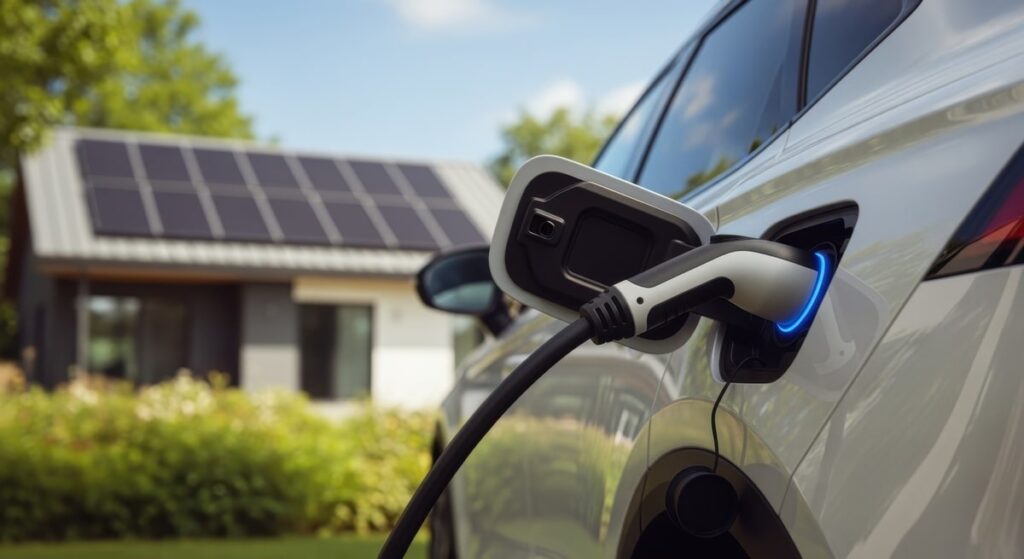
If with V2G we feed stored energy from the car into the grid available for general energy demand, with V2H technology the vehicle transmits the stored electricity exclusively to the home system.
What are the advantages of vehicle to home?
In V2H, the car works as a storage system and is able to transfer some amount of stored energy to the home system to make up for the home’s energy needs, perhaps at times of the day when demand is highest.
But where does this energy come from? To understand this we need to put two considerations together: the first is that most cars spend a great deal of time parked, and the second is that the overall system will evolve to make charging an increasingly frequent occasion not only on the road, but also at work at home and at commercial establishments. Energy that can be stored and transferred to the home system once you return.
The home self-consumption stream potentially has an interesting cost advantage on the bill (referring to the share of energy consumed at home).
It also makes energy access more feasible in the case of off-grid (island) installations of homes that are located in remote (but reachable by car) locations, such as mountainous areas.
Are there columns that allow bidirectional charging?
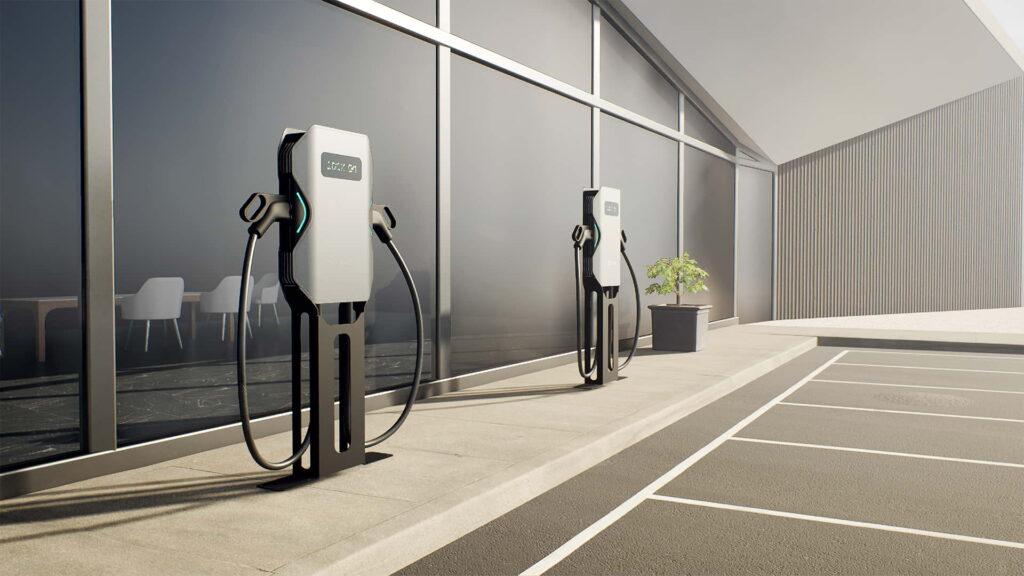
The two-way flow of electricity is only possible by taking advantage of special wall boxes and electric cars that provide this function. From the Smart Mobility Report 2022 we read:
“A large part of the IdRs (charging infrastructures) to date offered on the market appears to be predisposed to unidirectional modulation of the absorption load of electric vehicles. (…) In detail, more than 60 percent of the charging devices available on the Italian market are prepared to support V1G services (of these, more than 90 percent are AC IdRs with power up to 22 kW, while the remainder are DC IdRs with higher power). In contrast, charging devices to date on the Italian market that are prepared for bidirectional load modulation, i.e., V2G, are less than 1 percent of the devices offered.”
Silla Industries, thanks to fervent research and development, closes 2022 with the preparation of no less than two products suitable for bidirectional charging modulation. Officially unveiled at the Mondial de L’Auto in Paris, Duke 44 and Energy Hub 149 are aimed at business and home electrified ecosystems, respectively.
Energy Hub 149 is the ideal purchase for the 0-impact home, whether built from scratch or refurbished. It summarizes the entire electrified system for home use in a single device.
Especially suitable for plant systems capable of supporting its power, Duke 44 introduces DC charging to the market.
What lies ahead is a completely renewed perspective on energy, consumption and mobility. Not waiting for the new, but anticipating it, continues to be one of Silla Industries’ main missions.
V2G and V2H where are they now in 2026?
This article was written in October 2022, when bidirectionality was still a promise. A few years later, the picture has changed substantially, and 2026 marks the transition from experimentation to commercial reality.
The European regulatory framework has defined itself
As of January 8, 2026, in implementation of the European AFIR Regulation (EU Regulation 2025/656), all new public AC charging stations installed in the EU must support the ISO 15118 standard, the secure car-to-grid communication protocol that enables functions such as Plug & Charge and, in its most recent version ISO 15118-20 (mandatory as of 2027), true two-way charging.
Germany the progenitor of bidirectionality in Europe
In November 2025, the German Bundestag passed an amendment to the Energy Act (EnWG) that, effective January 1, 2026, equates electric vehicles with stationary storage systems: energy returned to the grid is no longer taxed twice. MiSpeL rules, which further simplify the technical implementation of V2G by eliminating the need for a second meter, also came into effect on April 1, 2026. A model that other European countries are watching with interest.
European research accelerates with V2X Cluster
The 75 pilot projects mentioned in the opening have been transformed into a coordinated program: the V2X Cluster Horizon Europe now brings together eight projects-SCALE, DriVe2X, EV4EU, FLOW, XL-Connect, AHEAD, NEVERFLAT, and ePowerMove-with more than 80 million euros of EU investment and active demonstration sites in 20 countries. The goal is to develop artificial intelligence algorithms capable of coordinating thousands of vehicles simultaneously for grid stabilization (FCR frequency regulation) and energy dispatch optimization, as documented in the DriVe2X project on CORDIS.
V2H becomes accessible
While V2G still requires integration with local grid operators, Vehicle-to-Home is already a market reality: in 2025/2026 brands such as Renault, Nissan, and the Volkswagen Group have launched production models equipped with bidirectional on-board chargers, and the first bidirectional DC home devices have appeared on the market, including Prism NG from Silla Industries, which allow the car to be used as an energy backup for the home and to maximize PV self-consumption. A detailed overview of the commercial status of V2G in some of the world’s most advanced countries on this issue is available in The Mobility House.
Silla Industries is ready
As just mentioned, Silla Industries has developed a native bidirectional wallbox, compliant with the ISO 15118-20 standard, designed to integrate Prism line products naturally into the V2H and V2G ecosystem. The future of smart charging is being built now.
Learn everything you need to know about the bidirectionality of Prism NG.