Do you want to charge your electric car at home and don’t know whether to choose a single-phase or three-phase wallbox? In this guide you’ll find technical explanations, usage scenarios, and practical tips for making the right choice based on your electrical system and vehicle type.
Choosing the correct wallbox for charging your electric car at home is crucial: the first factor to consider is the difference between single-phase and three-phase wallboxes. The decision depends on your electrical system, vehicle characteristics, and your specific charging needs.
Let’s explore together the technical differences between single-phase and three-phase wallboxes, the conditions required for installation, and how to choose the best wallbox to maximize the efficiency and speed of home charging.
Technical differences between single-phase or three-phase electrical system and impact on home charging
Understanding the technical distinction between single-phase and three-phase systems is the first step in making an informed choice.
Most common in Italian residential buildings, the single-phase system, operates at a nominal voltage of 230 V and can deliver a maximum current of up to 32 A(typical value 16 A). It requires 3 conductors: phase, neutral (active conductors) and earth (protective conductor). This corresponds to a theoretical maximum power of 7.4 kW.
However, the actual power available depends on the supply contract with the electric utility: in standard Italian homes, the limit is often 3 kW or 6 kW, unless upgraded. As a result, although the system can theoretically handle up to 7.4 kW, the power actually deliverable to the wallbox may be less, limiting the speed at which the electric vehicle can be recharged.
The three-phase system operates with a rated voltage of 400 V between phases and can deliver a maximum current of up to 32 A per phase. Requires 5 conductors : three phases and neutral (active conductors), plus earth (protective conductor). This results in a theoretical maximum power of 22 kW.
This is a rare configuration in standard homes, unless specifically requested, and is more common in settings such as single-family villas, buildings with PV systems of 6 kW or more, or in corporate settings.
Single-phase wallbox: when it is the right choice for home charging
The single-phase wallbox is the most common solution and suitable for most homes in Italy: in these cases installing a three-phase wallbox would be useless, as the existing system would not support it.
The single-phase wallbox is the correct choice if:
- your electrical system is single-phase (230 V);
- your electric car supports one-step charging;
- charging occurs mostly during night hours or in situations where charging time is not an urgent priority;
- do not plan to significantly increase contracted power or purchase future vehicles with three-phase chargers.
When it pays to install a three-phase wallbox and what advantages it offers
The three-phase wallbox offers the possibility of achieving significantly higher charging powers than single-phase, taking advantage of three phases of alternating current. For this reason, it represents an advantageous investment for those who need fast and flexible charging even in emergency situations or when the vehicle is used intensively.
This solution is particularly suitable for domestic settings with a prearranged system, semi-professional or business environments.
It makes sense to evaluate a three-phase system and go for a three-phase wallbox when:
- you already have a three-phase system (e.g., in high-end homes, villas, or semiprofessional and business installations);
- you intend to request three-phase activation to recharge vehicles that natively support a three-phase charger (e.g., models such as Tesla, BMW, Renault Zoe);
- With aPV system of 6 kW or more with a three-phase inverter, the installation of a three-phase wallbox allows not only more efficient charging, but also direct and optimal use of self-generated energy, maximizing self-consumption.
Home charging for electric cars: how to choose the ideal wallbox in 3 steps
To choose the most suitable wallbox best suited to the characteristics of your electrical system and your vehicle’s charging needs, it is critical to consider a few key aspects
- Check the type of system and power available: check whether your electrical system is single-phase or three-phase and what contracted power you have available.
- Check the capacity of the car’s on-board charger: every electric vehicle has an internal charger that determines the maximum power it can draw in alternating current (AC). If the car supports a maximum of 7.4 kW in single-phase, installing a three-phase wallbox will not benefit speed. If the car can draw 11 kW or 22 kW (AC), then you will need a three-phase wallbox, a three-phase home system, and an appropriate supply contract.
- Consider future vehicles: if you plan to purchase electric vehicles in the future that could benefit from three-phase charging, you might consider a modular or configurable three-phase wallbox. You could initially use it in single-phase mode, and then upgrade later without having to replace it.
Wallbox Prism: up to 22 kW, dynamic load management and remote configuration
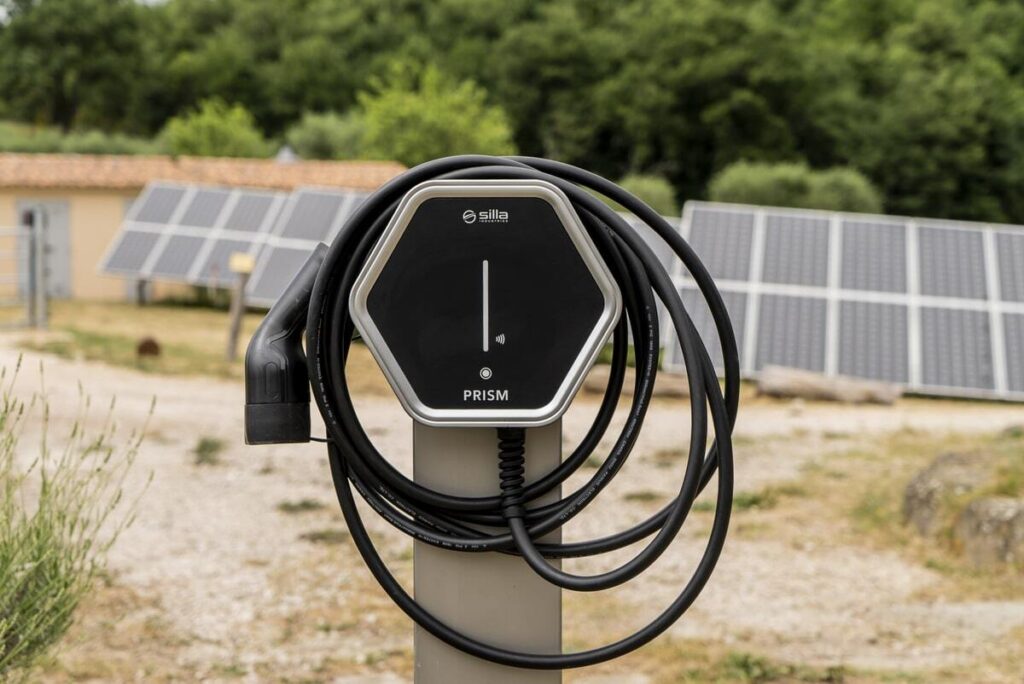
Silla Industries’ Prism wallbox is an example of advanced and flexible technology, available in both single-phase (up to 7.4 kW) and three-phase (up to 22 kW) versions.
All versions of Prism feature advanced and innovative features designed to provide a smart, safe and efficient charging experience. The system integrates Dynamic Load Management (DLM), which automatically balances the power absorbed by the car with the overall consumption of the home, preventing any overloading. It is also compatible with photovoltaic systems, even in a three-phase configuration, thus allowing the self-consumption of self-produced solar energy to be maximized. The configuration of the device can also be managed remotely, making it easy and immediate to make any updates or adjustments as the electrical system evolves.
How to choose the right charging cable for your electric car
The charging cable also has a major impact on the actual power the system can deliver. Compatibility between the cable, the vehicle, and the wallbox is a key issue.
A Type 1 cable allows only single-phase charging, with a maximum power of 7.4 kW.
A Type 2 single-phase cable, while having the same connector as the three-phase, limits charging to one phase, even if the wallbox and vehicle are both set up for three-phase.
To take full advantage of the potential of a three-phase charging system, it is essential to use a three-phase Type 2 cable, equipped with all seven active pins. Only with this configuration can the highest powers be achieved, ensuring optimal efficiency in charging the electric vehicle.
The versatility of this cable also makes it suitable for use on single-phase systems without any functional limitations, thus offering a unique solution for different charging scenarios.
To recognize a three-phase cable, simply observe the connector: if all pins are present and properly connected, it is a full-capacity three-phase version.
Wallbox and electrical system: final assessments to configure the ideal system
The decision between single-phase and three-phase wall boxes should be based on a careful evaluation of your current electrical system, the specifications of your electric vehicle, and your anticipated future charging needs.
The single-phase wallbox is the most practical and efficient solution for most standard domestic contexts, with compatible cars and when extremely high charging powers are not required. The three-phase wallbox is the recommended choice for more advanced systems, high-performance vehicles, corporate settings, or for those who want to better integrate charging with photovoltaic systems and three-phase inverters.
The Silla Industries team is available to provide you with personalized technical advice and help you configure the best solution for your facility and your vehicle.